7:40 on a Monday: running the morning cover desk
Two teachers call in sick before the first bell. What to decide before the phone rings, the ways to cover a lesson besides “find someone free”, how to keep it fair over a term, and what to tell staff and families — and what not to.
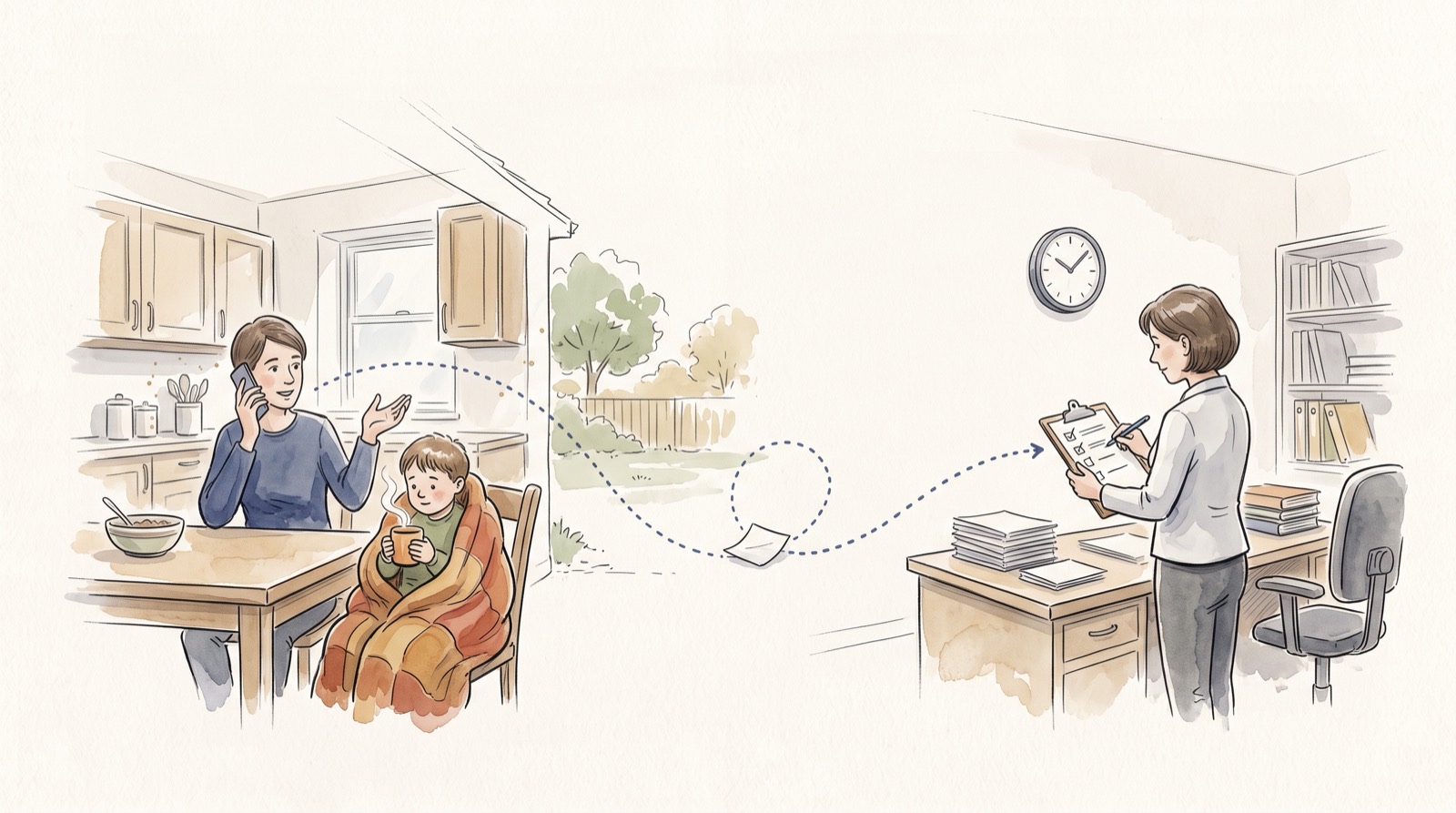
Of all the work in a school office, the cover desk has the shortest deadline. Between the first phone call and the first bell there are perhaps forty minutes, and in that time someone has to find a teacher, a room or another arrangement for every lesson of every colleague who is not coming in.
Many schools run this from a spreadsheet, a whiteboard and the memory of one deputy head. It works, until that person is the one who is ill. This guide is about making the morning repeatable: the decisions that belong to the term, not to 7:40, and the habits that keep the result fair and explainable.
Decide the rules before the phone rings
At twenty to eight nobody should be deciding policy. Four things can be settled once a term and written down:
- Who decides. The person at the desk assigns cover; school management approves planned absences such as training or leave, and is the only one who changes the rules below.
- Who is never asked. Some colleagues should not be offered cover — for health reasons, a reduced contract or a leadership role. Keep the list short, record a reason for each name, and keep the reasons between management and the person concerned.
- Who is on standby. A standby roster names, period by period, who is expected to be available. It turns the morning question from “who might be free?” into “who is on?”.
- What a class may lose. Older students can start later, finish earlier or work alone; the youngest classes cannot be sent home or left unsupervised. Write down from which year group each of those is acceptable.
There is more than one way to cover a lesson
“Find a free colleague” is the obvious answer and often the most expensive one. A good desk looks at the whole list before choosing:
| Way | What happens | What it costs |
|---|---|---|
| Standby | The teacher on standby for that period takes it | Nothing unplanned — that is what standby is for |
| Free colleague | Someone in school with a free period covers | Their preparation time |
| Swap | Another lesson of the same class, whose teacher is free now, moves into this slot; the absent teacher's lesson is taught later | Two timetables change, but no lesson is lost |
| Pull forward | The class's last lesson moves up and the class finishes early | Only for classes allowed to go home early |
| Move | The lesson is taught on another day | The class and teacher need a common free slot |
| Share | Two free colleagues split the lesson | Two short interruptions instead of one long one |
| Work alone | The class works on set tasks, with a teacher next door keeping an eye | Only for older classes, and only with work left |
| Merge | The class joins a parallel class | A crowded room |
| Cancel | The lesson does not happen | A lesson owed — see below |
A swap is the one most often missed. It needs no extra teacher at all: the class still gets every lesson, only in a different order. It is also the hardest to see on a whiteboard, because it means checking two teachers' weeks at once.
Who to ask first
When the answer is a colleague, the order matters as much as the choice. These are the things a good desk weighs, usually without saying so:
- Teaches the same subject, so the lesson can go ahead rather than become supervision.
- Knows the class — teaches it, or is its class teacher.
- Is on standby for that period.
- Is in school anyway: a free period between two lessons costs less than coming in early or staying late.
- Has covered least recently, and least this term.
- Works full time; a part-timer's free period is often not free at all.
- Is already covering the class's other lessons today, so the class sees one face rather than four.
Making these weights explicit has an effect beyond speed. When the reason sits next to each name — “teaches the class”, “covered this class last week”, “on standby” — the person at the desk can defend the choice, and the person asked can see why it was them.
Fairness is a count, not a feeling
Over a term, cover is one of the things staff watch most closely. The way to keep it fair is to count it: covers per person, per month and per term, next to each person's contract. Two details matter:
- Shared lessons count by the minute. Twenty-five minutes of a forty-five-minute lesson is 0.56 of a cover, not one and not zero.
- Corrections are separate entries. If a count is wrong, add an adjustment with a reason; do not overwrite the number. The record then still matches what actually happened.
Pay rules for cover differ widely — some systems pay every cover, some only those above a monthly threshold, some credit the time to a working-time account. Whatever the rule, it should be computed from the record, not from a separate list someone keeps by hand.
What to publish, and to whom
The cover plan is read by three audiences, and each needs something different:
- Staff need their own changes, early, and nothing else.
- Families and students need their class's changes: a later start, a room change, a cancelled lesson. They do not need to know which teacher is away, and never why.
- The building needs a screen in the entrance or the staffroom that shows today's and tomorrow's changes without anyone printing a list.
Two habits prevent most confusion. Publish deliberately, once the morning is settled, rather than as each decision is made. And when something changes after publishing, send each person only what changed for them — not the whole plan again.
How Bildena runs the cover desk
What you set up once. A standby roster per term (per A/B week where the school alternates), a never-ask list whose reasons only school management can read, and seven ranking weights — same subject, knows the class, standby, fairness, in school anyway, contract hours, continuity — each from 0 to 5. Which ways of covering a school may use follows its school type and can be switched; a German primary school, for example, does not get “pull forward” or “cancel”.
Each morning. An absence is entered with who, when and a reason; the reason is visible to management and the office only, colleagues see “away”. Every affected lesson then lists its ways out — standby, colleagues, swaps, moves, shares, merging, working alone — ranked, with the reasons shown as labels next to each name. A room out of use or a class away (on a trip, say) is entered in the same flow: lessons in that room get free rooms of the same type first, and a class away frees its teachers to cover.
Publishing. Nothing is sent until someone presses Publish. Staff get their own changes; families get their class's changes, without names and without reasons. Display screens in the building show today's and the next school day's changes from a secret link, and personal calendar feeds carry published changes only. Publishing again sends each person just what changed since they were last told.
The record. Computed from the covers actually given, per person and month or term, with shared lessons counted by the minute and corrections as separate entries with a reason. It exports to a CSV file for payroll, and an exported lesson is marked so it is never paid twice.
What it does not do. Cover never changes the base timetable. “Pull forward” only ever moves a class's last lesson of the day, and swaps and moves search the coming days, not the rest of the term. There is no direct link to a payroll system — the export is a file your payroll office imports.
A short checklist
- Once a term: standby roster, never-ask list with reasons, what each year group may lose.
- Agree who decides cover and who approves planned absences.
- At the desk: look at every way out before asking a colleague, swaps first.
- Ask in a known order, and keep the reason next to the name.
- Publish once the morning is settled; afterwards send only what changed.
- Count covers per person, shared lessons by the minute; correct with entries, not edits.
- Keep a list of lessons owed and close it before the end of term.
A good cover desk does not make absences painless. It makes the morning predictable — for the person at the desk, for the colleagues being asked, and for the classes whose day just changed.
In Bildena, cover sits in its own module next to the timetable: absences, the morning's suggestions, publishing to staff, families and screens, and the record for the end of the month.